
How Far Down Does the Demolition Go?
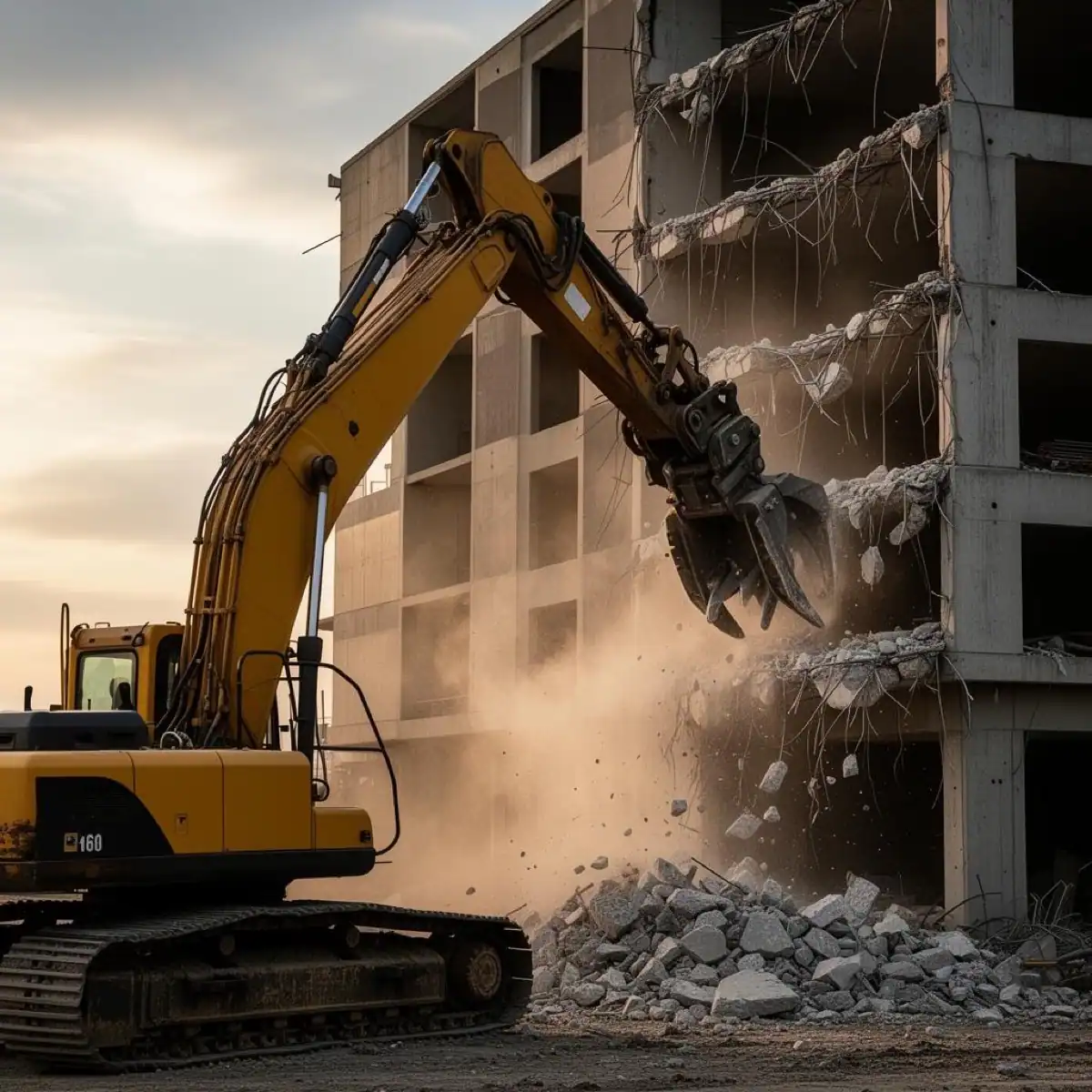
When people picture demolition they picture the building coming down. The part that decides the final cost is usually what happens after that, below grade.
The options, and what each means
Above-grade only. The structure comes down and everything at and below grade stays. Cheapest, and it leaves a slab that will limit whatever comes next.
Slab removal. The floor slab comes out. Substantial additional tonnage, and it exposes whatever is underneath.
Full foundation removal. Footings, grade beams, piers, pile caps — everything structural below grade. Considerably more excavation, and it produces a hole that has to be backfilled properly.
Everything, including below-grade structures. Pits, tunnels, basements, elevator pits, tank vaults, sumps, and underground utilities. On an industrial site this can be a bigger scope than the building was.
The right answer depends entirely on what the parcel is being used for next, which is why the demolition scope should be written after that is known rather than before.
Industrial slabs are not ordinary slabs
A warehouse slab might be six inches of lightly reinforced concrete. A manufacturing slab supporting presses, machine tools or heavy material handling can be several times that thickness, heavily reinforced, and sitting on engineered subgrade.
Equipment pads are worse. Machine foundations for large rotating equipment are frequently mass concrete extending well below the floor, sometimes with isolation details, sometimes with anchor systems, and always with far more tonnage than the visible footprint suggests.
An owner assuming an industrial slab prices like a warehouse slab is going to be surprised, and a contractor who did not investigate before bidding is going to be in a dispute.
What is under the floor
On any industrial building, the floor slab is not the bottom of the project. Underneath there is commonly:
- Process piping and drains, sometimes carrying residues that need characterising.
- Electrical conduit and duct banks.
- Compressed air and utility distribution.
- Trenches and pits, occasionally covered over decades ago and forgotten.
- Sumps and separators, which have their own contents.
Removing the slab exposes all of it, and the plan needs to account for the possibility. This is where a project's scope most often changes.
Backfill is a specification, not a task
Filling the hole is not simply pushing the spoil back in. If anything is going to be built on that ground, the backfill has to be suitable material, placed in defined lifts and compacted to a specification, with testing.
Uncontrolled fill produces settlement, and settlement under a future building is an expensive problem that surfaces years later. It is also exactly the corner that gets cut on a low bid.
The specification should be in the contract: what material, what lift thickness, what compaction standard, and what testing frequency. If the parcel is being sold rather than built on, that may relax — but it should be a decision rather than an omission.
Where crushed concrete fits
This is the natural pairing with on-site crushing. If foundations and slabs are coming out and the hole needs filling, processing that concrete into aggregate and using it as engineered fill removes both the haul-out and the import.
It requires clean separation and material meeting specification, and where those conditions hold it is the single largest cost saving available on a foundation removal scope.
Decide it before you bid
The most useful thing an owner can do is decide the final site condition before soliciting prices, and write it into the scope: what comes out, to what depth, backfilled with what, compacted to what standard, graded how.
Bids against that specification are comparable. Bids against "demolish the building" are not, and the difference between them will be exactly this scope.
Need an interior stripped?
Nationwide interior demolition crews. Fast scheduling. Clean hand-offs.
Request a Demo QuoteMore in Demolition
Strip Mall and Retail Center Demolition in Florida
Older retail centers are coming down across Florida for redevelopment. Here is what drives the cost and schedule on a strip mall teardown.
Gas Station Demolition: What Is Actually Involved
A gas station teardown is a tank closure, a canopy removal, and a building demolition rolled into one regulated project. Here is how it sequences.
Hotel and Motel Demolition in Florida
Florida's aging roadside motels and mid-century hotels are prime redevelopment sites. What drives cost and schedule when one comes down.