
Five Things a Demolition Contractor Should Tell You Before Signing
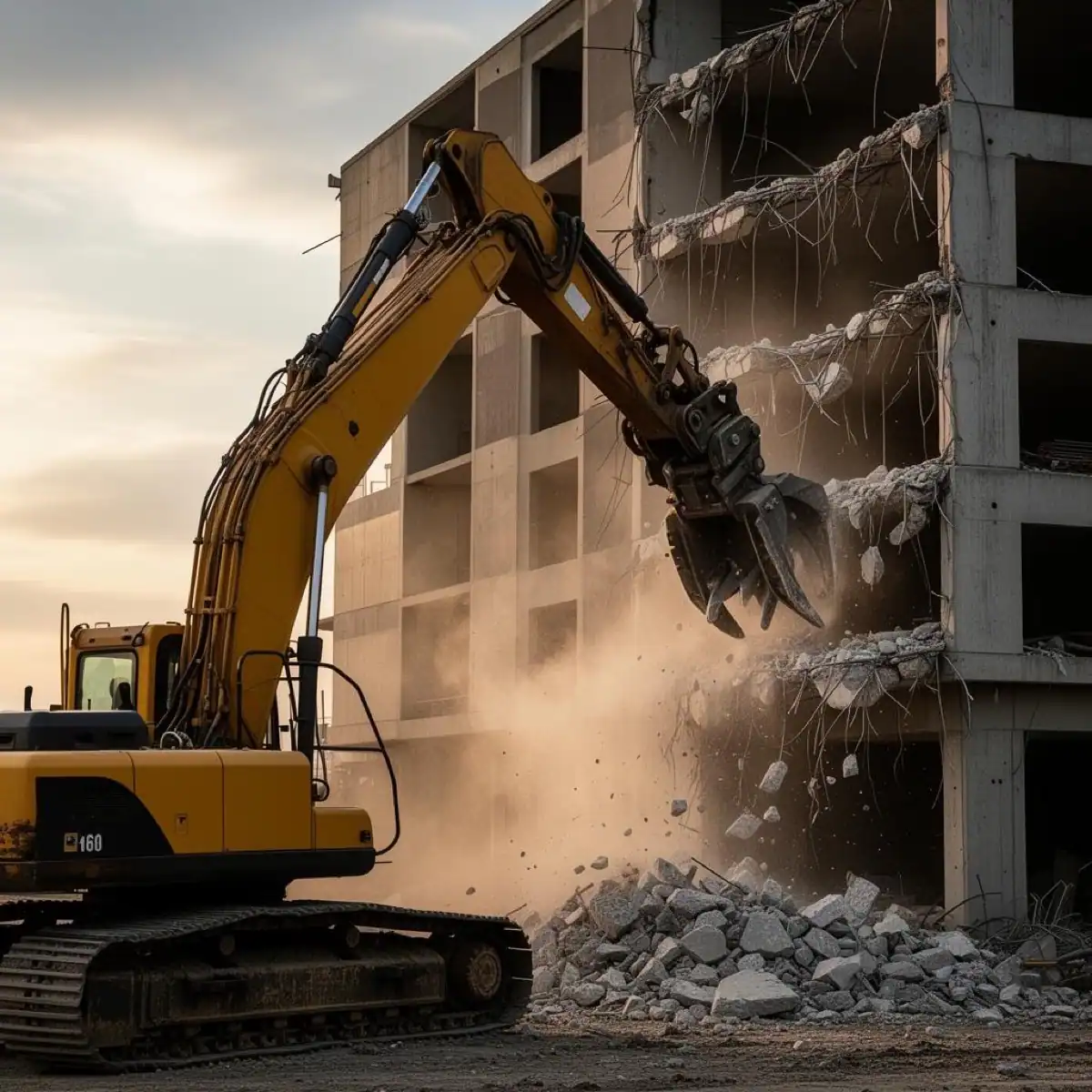
Demolition bids are hard to compare because the number depends entirely on what is behind it. Here is what a contractor should be telling you unprompted, and what it means when they do not.
1. Exactly where the scope stops
Above grade only, or slabs, or foundations, or below-grade structures. What happens to paving, fencing, underground utilities and tanks. What the site looks like when they leave.
A contractor who has not asked what you intend to do with the parcel afterward has not scoped the job — they have priced a building. Those are different things and the gap between them is usually the largest number in the project.
2. What they expect to find, and what happens then
Every demolition encounters something. A contractor who has walked your building should be able to say what they expect: likely asbestos locations given the age, whether the slab thickness is a question mark, whether there are pits or tanks that need investigating, whether the adjacent structure is a concern.
More importantly, the contract should say how unknown conditions get handled — how they are documented, how they are priced, and who decides.
A bid that assumes nothing unexpected happens is a bid that will produce change orders. The question is whether you knew that going in.
3. What the equipment is worth, as a separate number
On any industrial or commercial building with mechanical and electrical infrastructure, there is recoverable value. Chillers, transformers, switchgear, motor control centers, compressors, generators, cranes.
You should see two figures: the demolition price and the equipment recovery credit. Netted into one number, you have no way of knowing whether the credit is fair or whether the contractor is keeping value you did not know existed.
Ask for the inventory. A contractor confident in their appraisal will show it to you.
4. What controls the schedule, honestly
Almost never the demolition itself. It is the asbestos survey and abatement, the utility disconnections, and the permit.
A contractor who gives you a schedule starting from mobilization without addressing those three is giving you a schedule that will not hold. The useful version says when the utility requests need to go in, how long the abatement is expected to take, and what the permit turnaround is in your jurisdiction.
5. What could make this project go badly
The most informative question you can ask, and the answer separates contractors immediately.
A good answer is specific to your building: the adjacent structure, the unknown below the slab, the tank nobody has records for, the utility service that may take longer than usual, the possibility that the abatement scope grows.
A contractor who says nothing will go wrong has either not looked or is telling you what they think you want to hear. Neither is what you want in the party responsible for taking a building down next to your other assets.
What to do with the answers
Compare bids on scope rather than on price. Where two numbers differ substantially, the difference is nearly always something one contractor included and the other excluded — depth of removal, backfill specification, abatement allowance, or the equipment credit.
Get those aligned and the comparison becomes meaningful. Until then, the low bid is usually just the one that assumed the least.
Need an interior stripped?
Nationwide interior demolition crews. Fast scheduling. Clean hand-offs.
Request a Demo QuoteMore in Demolition
Strip Mall and Retail Center Demolition in Florida
Older retail centers are coming down across Florida for redevelopment. Here is what drives the cost and schedule on a strip mall teardown.
Gas Station Demolition: What Is Actually Involved
A gas station teardown is a tank closure, a canopy removal, and a building demolition rolled into one regulated project. Here is how it sequences.
Hotel and Motel Demolition in Florida
Florida's aging roadside motels and mid-century hotels are prime redevelopment sites. What drives cost and schedule when one comes down.