
Warehouse Demolition Cost in Florida: What Drives the Number
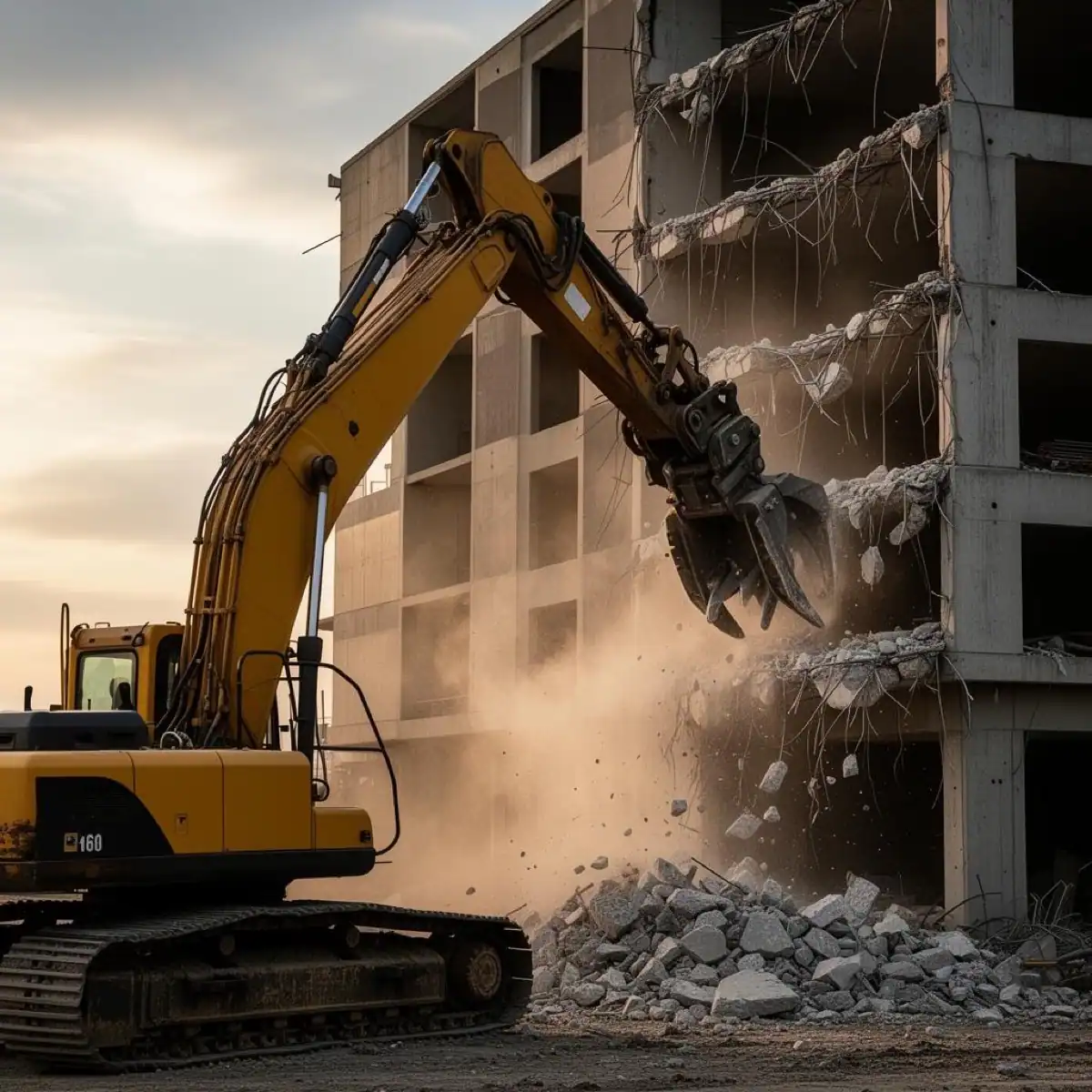
Warehouse demolition gets quoted by the square foot more often than any other kind of teardown, and that is exactly why the numbers people find online are so misleading. A pre-engineered metal building on a thin slab and a 1960s concrete tilt-wall with a mezzanine, a sprinkler riser, and a rail spur are both "warehouses," and they are not remotely the same job. Here is what actually moves the price on a Florida warehouse demolition.
Structure type is the first fork in the road
Metal buildings come down fast. The skin peels, the purlins and frames unbolt or get cut, and most of what hits the ground is steel that has value. Those are the cheapest warehouses per square foot we bid, and on a clean site with good steel prices the salvage does real work against the bill.
Concrete tilt-wall and masonry are a different animal. Panels have to be dropped in a controlled sequence, broken down small enough to load, and hauled as heavy tonnage. Concrete is priced by weight going out the gate, so a tilt-wall building costs more to demolish than a metal building of the same footprint almost every time.
Wood and older brick industrial stock sits in the middle — easy to bring down, but the debris is mixed, which means sorting and higher landfill rates than clean concrete or steel.
Square footage is not the whole story — height and structure density are
Two 40,000 sq ft warehouses can differ by 50% in price if one is a 16-foot clear-span shell and the other is a 32-foot building with heavy racking, a mezzanine office, and a full sprinkler system. What you are really paying for is cubic volume of material and the labor to get it safely to the ground, not floor area.
Interior build-out matters just as much. A shell with nothing in it is straightforward. A warehouse with 8,000 sq ft of office, dock levelers, freezer panels, and a compressed-air loop has a whole interior strip-out phase in front of the structural work — which is really interior demolition priced before the building ever comes down.
Slab and foundation removal is the line item people forget
The single most common budget surprise on a warehouse teardown is the slab. Removing a 6-inch slab across 40,000 sq ft is thousands of tons of concrete to break, load, haul, and tip. If the redevelopment plan lets you leave the slab in place — and plenty do, especially when the new build reuses the pad — you can cut a meaningful chunk out of the quote.
So ask the question early: does the buyer, the site plan, or the permit actually require the slab and footers out? If nobody has decided yet, decide before you take bids, because the two scenarios are not comparable quotes.
Abatement and hazardous materials
Any Florida commercial building built before roughly 1990 needs an asbestos survey before a permit is issued. Transite panels, roofing felt, mastic under the flooring, pipe insulation, and window glazing are the usual finds. Add lead paint on older steel, mercury in thermostats and switches, ballasts in the light fixtures, and refrigerant in any cooling equipment.
Abatement is its own licensed scope and its own line item. It is not padding — it is regulatory, and skipping the survey is how projects get red-tagged. Budget for the survey up front, and treat the abatement number as unknown until the survey comes back.
What is still inside the building — and what it is worth
This is where a warehouse teardown differs from residential demolition, and where the number can move in your favor. Before anything comes down, the building's mechanical and electrical backbone often still has real resale value: rooftop units, chillers, transformers, switchgear, air compressors, dock equipment, racking, and copper.
Because we buy and resell that equipment ourselves, we appraise it before we quote the demolition and credit the recovery value against the job. On a well-equipped facility that offset is not decoration — it can take a serious bite out of the total. The full logic is in how equipment recovery offsets demolition cost.
Site access, neighbors, and schedule
A building sitting alone on five acres with a wide gate is cheap to work. A building attached to an occupied tenant space, tight against a property line, or inside a live distribution yard costs more because of protection, sequencing, dust and noise control, and restricted work hours. If trucks have to stage on a public street or the site can only take one load-out lane, throughput drops and the schedule stretches.
How to get a quote you can actually compare
Get every bidder working from the same scope: slab in or out, abatement included or excluded, equipment recovery credited or not, and who pulls the permit. Ask for tonnage assumptions, not just a lump sum. Then the difference between two bids is a real difference, not a scope mismatch.
We demolish warehouses and distribution facilities across Florida and recover the equipment inside so the value stays on your side of the ledger. Call (689) 323-4676 or request a quote — and if the property is in a metro we work constantly, start at industrial demolition in Florida.
Need an interior stripped?
Nationwide interior demolition crews. Fast scheduling. Clean hand-offs.
Request a Demo QuoteMore in Demolition
Strip Mall and Retail Center Demolition in Florida
Older retail centers are coming down across Florida for redevelopment. Here is what drives the cost and schedule on a strip mall teardown.
Gas Station Demolition: What Is Actually Involved
A gas station teardown is a tank closure, a canopy removal, and a building demolition rolled into one regulated project. Here is how it sequences.
Hotel and Motel Demolition in Florida
Florida's aging roadside motels and mid-century hotels are prime redevelopment sites. What drives cost and schedule when one comes down.