
What Is a Used Boiler Worth?
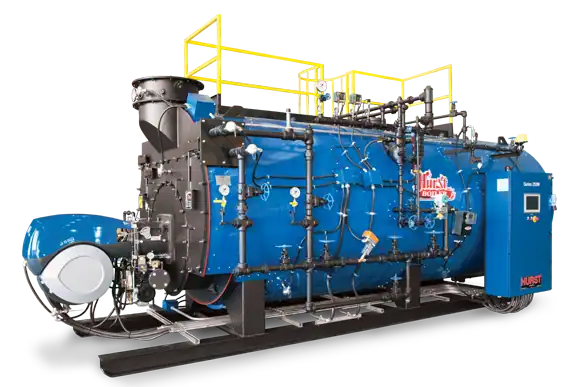
Owners decommissioning a boiler room usually have the same question: is this thing worth anything, or is it scrap? The answer depends on a handful of factors that a buyer checks in a specific order, and knowing them lets you predict roughly where the offer will land before you make the call.
Type and capacity
Packaged firetube boilers in common commercial and light industrial sizes are the most liquid segment of the used market. There are a lot of buildings that use them, and a serviceable unit finds a buyer. Condensing hot water boilers of recent vintage also move. Large watertube boilers are a narrower market; there are fewer buyers with a use for one, and the units are harder to move, so the value has to clear those hurdles.
Capacity matters in both directions. Very small units are not worth much because the removal and transport cost is high relative to the value. Very large units are constrained by the number of buyers. The middle of the range is where demand is strongest. The design differences are laid out in firetube vs watertube used boilers.
Age and fuel
Newer is worth more, but age matters less than condition and configuration. A well-maintained twenty-year-old firetube with a modern burner can be worth more than a younger unit that was run hard with poor water treatment. Natural gas and dual-fuel units are more marketable than oil-only units, because most buyers have gas.
Burner and controls
A boiler is a pressure vessel with a burner and a control system attached, and buyers value all three. A boiler with a current burner from a major manufacturer and a working combustion control and safety system is a package someone can install. A boiler whose burner is obsolete or whose controls are stripped is a vessel that needs a burner project, and the offer reflects that cost.
If the burner and controls are intact, leave them intact. Owners sometimes let a controls contractor salvage parts before the boiler is sold, and it destroys more value than it recovers.
Inspection history and documentation
A boiler with a legible nameplate, a national board number, and a recent internal inspection report is easy to sell because the buyer can get it certified where it is going. A boiler with no records has to be inspected from scratch and carries the risk that the inspection finds a problem. Documentation is worth real money here. Find the inspection certificates, the manufacturer's data report, and any tube replacement records before the buyer arrives.
Condition of the vessel
Tube leaks, tube sheet corrosion, shell pitting, and cracked refractory all reduce value, and a buyer will look for them. Water treatment history is the best predictor. A boiler that was on a maintained treatment program is generally sound inside; one that was not is likely to have scale and corrosion that show up on inspection.
Removal access
This is the factor sellers most often overlook. A boiler in a ground-floor room with a door to the outside is cheap to remove and its full value is available. A boiler in a basement, or behind a wall that has to be opened, or on a mezzanine, costs significantly more to extract, and the buyer subtracts that cost from the offer. In some cases the extraction cost exceeds the value, and the boiler is cut up in place for scrap. The general principle is in why removal access changes what your equipment is worth.
If the building is being demolished, that changes the math in the seller's favor. A wall that is coming down anyway is not an obstacle, and a boiler that would have been cut up can come out whole.
When scrap is the answer
Old, oil-only, undocumented, or damaged boilers are usually worth more as scrap than as equipment, and there is nothing wrong with that outcome. A boiler is a lot of steel, and the scrap value is real. The mistake is assuming scrap is the answer without checking, because a surprising number of boilers that owners write off are units a buyer wants.
Frequently Asked Questions
How do I get an offer?
Send the nameplate information, photographs of the boiler, burner, and controls, the inspection records, and a description of the removal route. We buy used boilers and respond with a cash offer.
Does the boiler have to be running?
No, but it helps. A boiler that was running recently and was shut down properly is worth more than one that has been cold for years.
Who handles the removal?
We do. Our offers include rigging and removal, and the removal cost is already accounted for in the number.
What if the boiler has asbestos insulation?
The insulation is abated before removal, and that cost is part of the project. The boiler itself can still have value once it is clean.
Demo Dynasty buys used boilers and other industrial equipment nationwide from Auburndale, FL. Call (689) 323-4676 or get a cash offer.
Got equipment to sell?
Cash offers in 24–48 hours. Nationwide pickup. Any condition.
Get a Cash OfferMore in Selling Equipment
Selling a Chiller Plant: Whole or Piece by Piece?
A complete central plant sometimes sells better as a system than as components. Here is how to tell which case you are in.
Why Removal Access Changes What Your Equipment Is Worth
A buyer prices the equipment and the extraction together. What you can do about access, and what it is worth.
What Actually Determines Used Equipment Resale Value
Age matters less than most sellers assume. Condition, documentation, removal difficulty and market depth matter more.