
Concrete Slab Removal Cost: What It Takes to Get a Pad Out
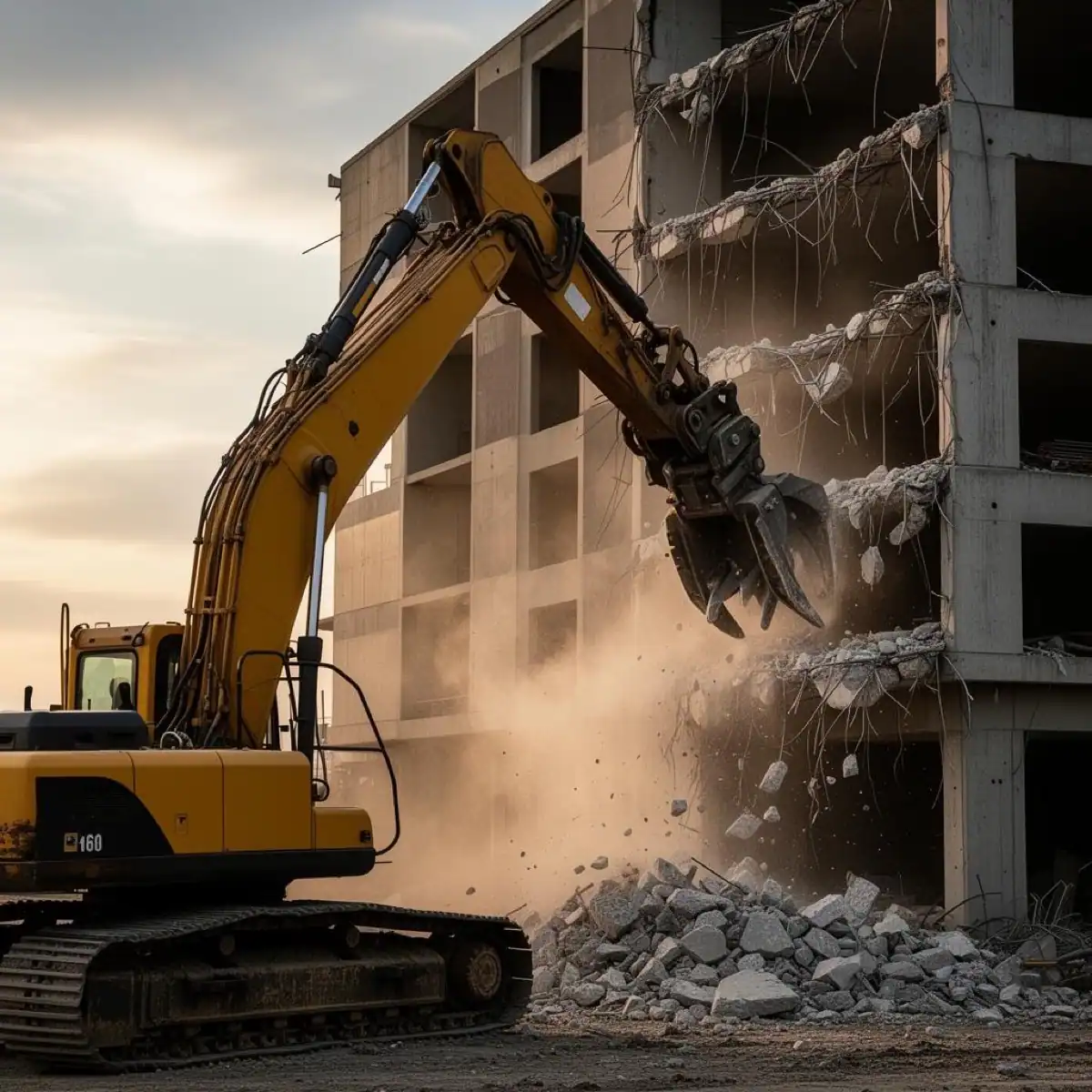
Concrete is the heaviest thing on most demolition sites, and weight is what you pay for. A slab that looks like a flat gray rectangle on a site plan is, in practice, a few thousand tons of material that has to be broken, loaded, trucked, and tipped. Understanding how that math works is the difference between a slab line item that makes sense and one that blindsides your budget.
Start with tonnage, not square feet
Concrete runs roughly 150 pounds per cubic foot. A 6-inch slab is half a cubic foot per square foot of area, so every 1,000 square feet of 6-inch slab is on the order of 37 tons of material. Scale that: a 40,000 sq ft warehouse pad at 6 inches is roughly 1,500 tons. At typical truck capacity that is dozens of loaded trips just for the floor.
That is why slab removal quotes track thickness so closely. Going from 4 inches to 8 inches doubles the tonnage — and roughly doubles the hauling and disposal side of the bill — while the square footage on the drawing never changes.
What actually drives the price
Thickness. The single biggest multiplier. Confirm it with a core sample or an old drawing, not a guess. Industrial slabs are frequently thicker than anyone remembers, and heavy-equipment pads under presses, tanks, or racking can be a foot or more.
Reinforcement. Wire mesh breaks up easily. Rebar on a tight grid means slower breaking, cutting, and separating steel from concrete before it can be recycled or tipped. Post-tensioned slabs are a different job entirely and must be de-tensioned safely — never treat a post-tensioned slab as ordinary concrete.
Access. An open lot where an excavator can work and a truck can back to the pile is efficient. A slab inside a standing building, behind a wall, or in a courtyard means small equipment, hand-loading, or conveyor work, and the productivity drops hard.
Disposal distance and destination. Clean concrete can often go to a recycler and be crushed for base material, sometimes at a lower tip fee than landfill and occasionally with a rebate. Concrete contaminated with soil, asphalt, or coatings gets treated as mixed debris at a higher rate. Sorting on site pays for itself.
Subgrade and footers. Removing the slab is one scope; removing the perimeter footings, grade beams, and equipment pier foundations is another. Deep footers mean excavation, backfill, and compaction — with imported fill charged by the yard.
When you can leave the slab in place
Plenty of redevelopment plans reuse an existing pad, and a sound slab is genuinely valuable. If the new structure sits on the same footprint, if the site becomes parking or laydown, or if the buyer plans a cap rather than a dig, keeping the slab can remove one of the largest line items from your demolition budget entirely.
Before you assume you must remove it, get an answer from the site civil engineer and the permit reviewer. We have quoted plenty of jobs where nobody had actually asked, and the answer turned out to be "leave it."
Recycling: the part that helps you
Clean concrete is one of the most recyclable materials on a demolition site. Crushed on site or at a recycler, it becomes base material for roads and pads. Two things make it work: keeping it clean, and keeping the rebar separated. Steel pulled out of a slab has scrap value of its own, and on heavily reinforced industrial slabs that offset is not trivial.
If your site can accept crushed material as fill, on-site crushing can eliminate a big share of the haul-off entirely — you stop paying to truck material out and then truck fill back in.
Slabs inside a bigger demolition scope
Most of the slab work we do is part of a full building teardown, which is where sequencing matters. Structure comes down, debris is sorted and hauled, then the slab and footers come out, then the site is graded. Trying to pull the slab while the structure is still standing costs more and accomplishes less.
If the building above the slab has mechanical or electrical equipment still installed, that gets recovered before anything else moves — see industrial demolition vs. equipment salvage for how that trade-off is scoped.
Getting a real number for your site
To quote slab removal accurately, we want the footprint, the thickness (measured, ideally), whether it is mesh or rebar or post-tensioned, whether footers and equipment pads come out, what access looks like for trucks, and whether the site can accept crushed material as fill. With those answers a slab quote is straightforward. Without them, any number you get is a placeholder.
We remove slabs, footers, and equipment foundations across Florida as part of full demolition and site-clearing scopes. Call (689) 323-4676 or get a quote. See also: warehouse demolition cost in Florida and debris removal.
Need an interior stripped?
Nationwide interior demolition crews. Fast scheduling. Clean hand-offs.
Request a Demo QuoteMore in Demolition
Strip Mall and Retail Center Demolition in Florida
Older retail centers are coming down across Florida for redevelopment. Here is what drives the cost and schedule on a strip mall teardown.
Gas Station Demolition: What Is Actually Involved
A gas station teardown is a tank closure, a canopy removal, and a building demolition rolled into one regulated project. Here is how it sequences.
Hotel and Motel Demolition in Florida
Florida's aging roadside motels and mid-century hotels are prime redevelopment sites. What drives cost and schedule when one comes down.