
How Long Does It Take to Gut a House?
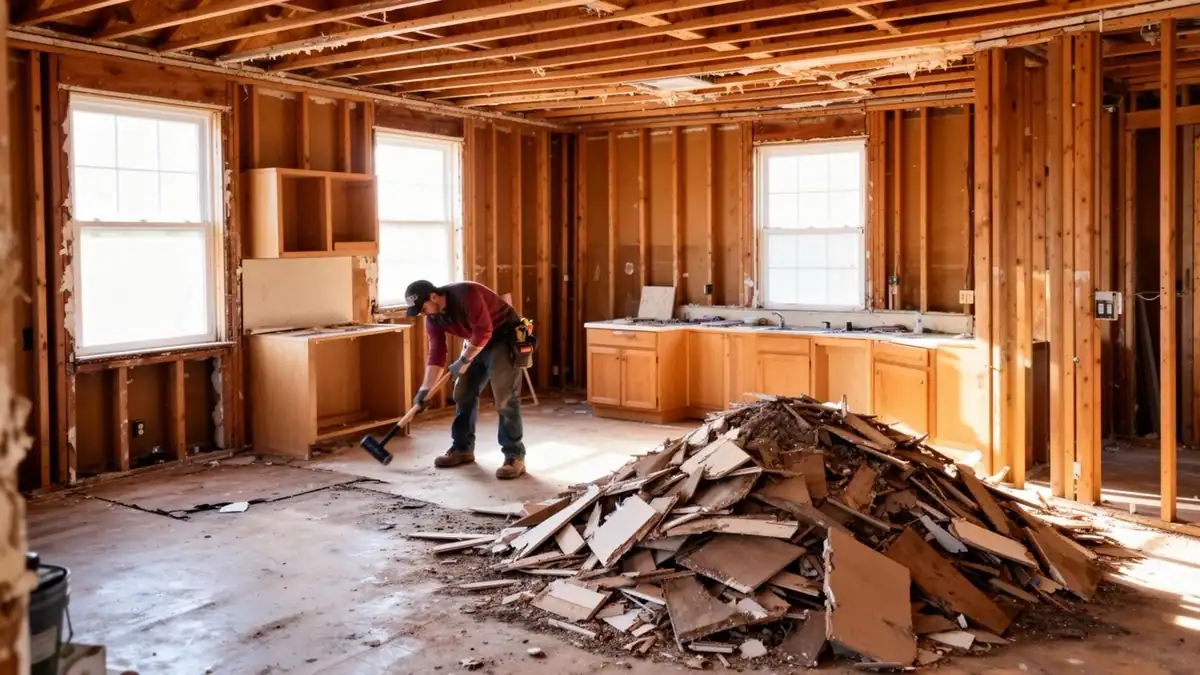
On a flip, every day the house sits is money — interest, insurance, taxes, utilities, and the opportunity cost of capital parked in a building nobody can work in. So the honest answer to "how long does a gut take" matters more than it seems.
The short version: with a properly sized crew and a container on site, most single-family gut jobs run two to five days. The reason so many take three weeks is almost never the size of the house.
Realistic durations by scope
Cosmetic strip — flooring, fixtures, cabinets, appliances. A 1,500 sq ft house: 1 to 2 days.
Partial gut — kitchen and baths to studs, selected walls, some mechanical. A 1,500 sq ft house: 2 to 3 days.
Full gut to studs — all drywall or plaster, ceilings, flooring to subfloor, all cabinetry and fixtures, all MEP removed. A 1,500 sq ft house: 3 to 5 days. A 3,000 sq ft house: 5 to 8 days.
Gut to frame with layout changes — add structural work, shoring, and engineering coordination. Add 2 to 5 days, plus inspection scheduling that you do not control.
Multi-unit and small commercial scale roughly with square footage, but with better efficiency per square foot because crews are not constantly repositioning.
What actually sets the pace
Crew size, correctly matched. Gutting is parallelizable up to a point — more hands genuinely means faster on a full gut. A four-person crew on a 1,500 sq ft full gut is the sweet spot; two people take more than twice as long because hauling becomes the bottleneck.
Container logistics. This is the real hidden constraint. If the crew fills the dumpster on day two and the swap does not arrive until day four, the crew stops. Good contractors schedule swaps in advance and stage a second container on larger jobs. Ask how many pulls are in the price.
Access. Ground floor with a driveway is the fast case. Every stair flight, long carry, or street-parking dumpster permit adds hours to the same volume of material.
Plaster vs. drywall. Plaster-and-lath is slower to remove and generates several times the debris. An older house is genuinely a longer job even at identical square footage.
Utilities already disconnected. If power, water, and gas still need to be handled when the crew shows up, day one gets consumed by coordination instead of work. Handle it before mobilization.
What causes the three-week gut
Almost always one of these four:
- Undiscovered hazardous material. Asbestos found mid-demo stops work cold until a licensed abatement contractor completes the scope with its own schedule. Test first — this is the single biggest schedule risk on a pre-1990 property.
- Scope creep. The wall that "might as well" come out becomes a structural question, which becomes an engineer, which becomes an inspection.
- Undersized crew. A cheap bid that assumes two people can do a four-person job.
- Debris pileup. No container swap scheduled, so material stacks in the yard and the crew starts stepping over its own work.
How to compress the schedule
- Test for lead and asbestos before closing or immediately after, so results are in hand before mobilization.
- Disconnect utilities in advance.
- Give the crew a written, final scope. Changes mid-demo are the expensive kind.
- Confirm container count and swap scheduling as part of the quote.
- Get the structural decisions made and engineered before demo starts, not discovered during.
- Book demo and the next trade together so the framer or plumber starts the day after the crew leaves, not two weeks later.
The carrying-cost math
On a property with $150 a day in carrying cost, the difference between a five-day gut and a twenty-day gut is over $2,000 — often more than the difference between the cheap bid and the fast one. And the fast crew usually leaves a cleaner building, which saves the next trade time too.
That is why volume investors mostly stop shopping demo on price alone after their first few projects.
What "done" should look like
Everything in scope removed, the structure swept, debris hauled, no container left behind, and photos of anything unexpected found in the walls. The next trade should be able to start the following morning without touching a broom.
We gut houses and small commercial interiors across Florida on investor schedules, typically 2 to 5 days for a standard full gut, with fixed pricing and repeat-client rates. See house gutting or read gut renovation cost per square foot.
Call (689) 323-4676 or request a quote.
Fix-and-flip or rehab portfolio?
House gut-outs in 2–5 days. Volume pricing for repeat investors.
Get an Investor QuoteMore in Investor Guides
What It Costs to Get an Industrial Parcel Development-Ready
Between buying a closed plant and putting something new on it sits a set of costs that are predictable if you ask for them.

Buying a Closed Industrial Plant: What to Check First
Closed plants trade at a discount for reasons. Environmental status, structure, equipment and demolition cost decide whether the discount is real.
Gutting a House After Water Damage in Florida
Flooded and storm-damaged houses need a specific kind of gut-out, fast. What comes out, how far up the wall, and why the clock matters in Florida's climate.