
Industrial Demolition in Sarasota and Bradenton
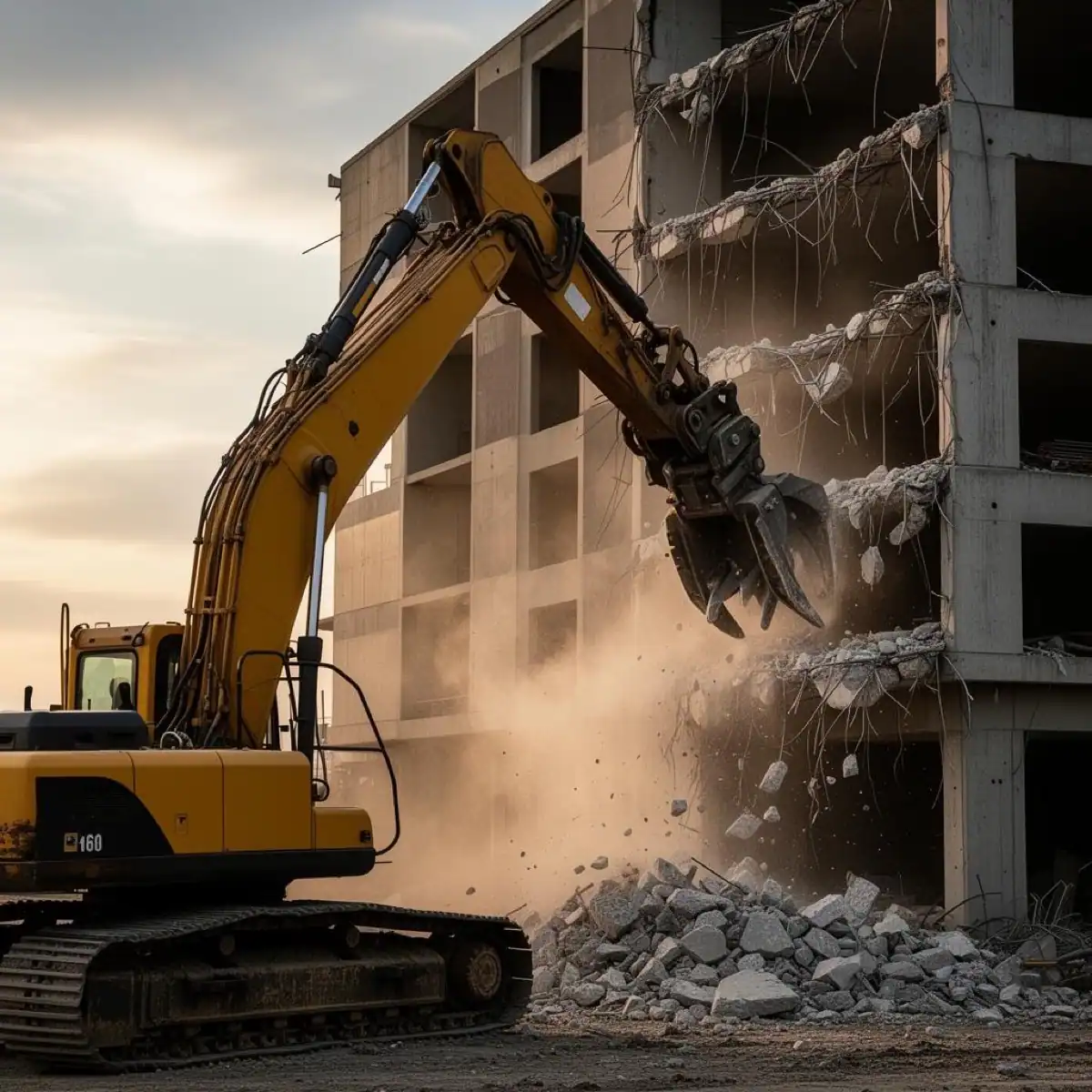
The Sarasota–Bradenton corridor is one of the more interesting demolition markets in Florida because two very different forces drive the work. On the Manatee County side there is genuine heavy industry around Port Manatee and the US-41 corridor. On the Sarasota side there is relentless redevelopment pressure, where older commercial and light-industrial buildings sit on land that is now worth far more than the structure on it.
Both produce teardowns. They produce very different teardowns.
Manatee County: real industrial work
Port Manatee anchors a genuine industrial base — bulk handling, cold storage, fuel and chemical terminals, agricultural processing, and the distribution and light manufacturing that clusters around a working port. Facilities in this zone tend to carry serious mechanical and electrical infrastructure: refrigeration plants, boilers, large services with transformers and switchgear, pumps, and process piping.
When one of these facilities is retired, the equipment inside it is frequently worth more than the scrap value of the whole building. That is the core of how we scope this work — appraise the contents first, then price the demolition net of what we can recover.
Agricultural processing is its own category on the Suncoast. Packing houses, citrus and produce facilities, and cold storage all carry substantial refrigeration, which means refrigerant recovery obligations and, on the upside, chillers and cooling equipment with real resale value.
Sarasota: redevelopment demolition
Closer to Sarasota the pattern shifts toward clearing land. Older strip commercial, light-industrial and warehouse buildings, service garages, and mid-century structures come down so a higher-value use can go up. These jobs are usually smaller in footprint but tighter in constraints: neighbors, traffic, restricted hours, and site access that will not accommodate a full equipment spread.
Two things dominate the budget on these projects. First, the slab and foundations — redevelopment almost always requires them out, unlike an industrial reuse where a pad might stay. Second, abatement, because mid-century Florida commercial construction is full of the materials an asbestos survey flags.
Permitting on both sides of the county line
Sarasota County, Manatee County, and the cities of Sarasota, Bradenton, and Palmetto each run their own building departments, and the review pace varies. The state-level requirements do not: licensed contractor, asbestos survey before application, NESHAP notification with its ten-working-day clock, and documented utility disconnects.
Coastal proximity adds a wrinkle worth flagging early — properties near the water can pull in stormwater, environmental, and sometimes coastal construction review that a landlocked parcel would not face. Identify that in week one, not week six.
Distance and how we work it
Our yard is in Auburndale, in Polk County, roughly an hour and a half east of the Bradenton–Sarasota area. That is comfortably within routine working range for us — closer than Jacksonville or Miami — so Suncoast projects run as normal work rather than a special mobilization, and we can get someone on site for a walk-through quickly.
Where the recovery value shows up here
Suncoast facilities that reliably carry recoverable equipment:
- Cold storage and food processing — refrigeration plants, chillers, condensers, evaporators, ammonia systems
- Port-adjacent industrial — pumps, motors, large electrical services, compressors
- Manufacturing — machine tools, air compressors, dust collection, cranes
- Hospitality and institutional conversions — large chillers, boilers, generators, and switchgear from hotels and older commercial buildings
Because we buy this equipment ourselves and resell it, our appraisal is a real offer rather than a theoretical salvage estimate. See used equipment for sale for what moves through the yard.
A realistic schedule
For a straightforward Suncoast commercial or light-industrial teardown with a clean survey, plan on roughly six to ten weeks from decision to a graded site, with permits and notification consuming most of the front half. Add abatement time if the survey finds material, and add review time for anything coastal or historic.
Get your Sarasota or Bradenton project scoped
Tell us the building type, the square footage, what mechanical and electrical equipment is still installed, and whether the slab has to come out. We will come back with a real scope and an honest recovery number.
Call (689) 323-4676 or request a quote. Related: industrial demolition across Florida, plant cleanup.
Need an interior stripped?
Nationwide interior demolition crews. Fast scheduling. Clean hand-offs.
Request a Demo QuoteMore in Demolition
Strip Mall and Retail Center Demolition in Florida
Older retail centers are coming down across Florida for redevelopment. Here is what drives the cost and schedule on a strip mall teardown.
Gas Station Demolition: What Is Actually Involved
A gas station teardown is a tank closure, a canopy removal, and a building demolition rolled into one regulated project. Here is how it sequences.
Hotel and Motel Demolition in Florida
Florida's aging roadside motels and mid-century hotels are prime redevelopment sites. What drives cost and schedule when one comes down.