
Mold Remediation vs. Gutting: Which One Does Your Property Need?
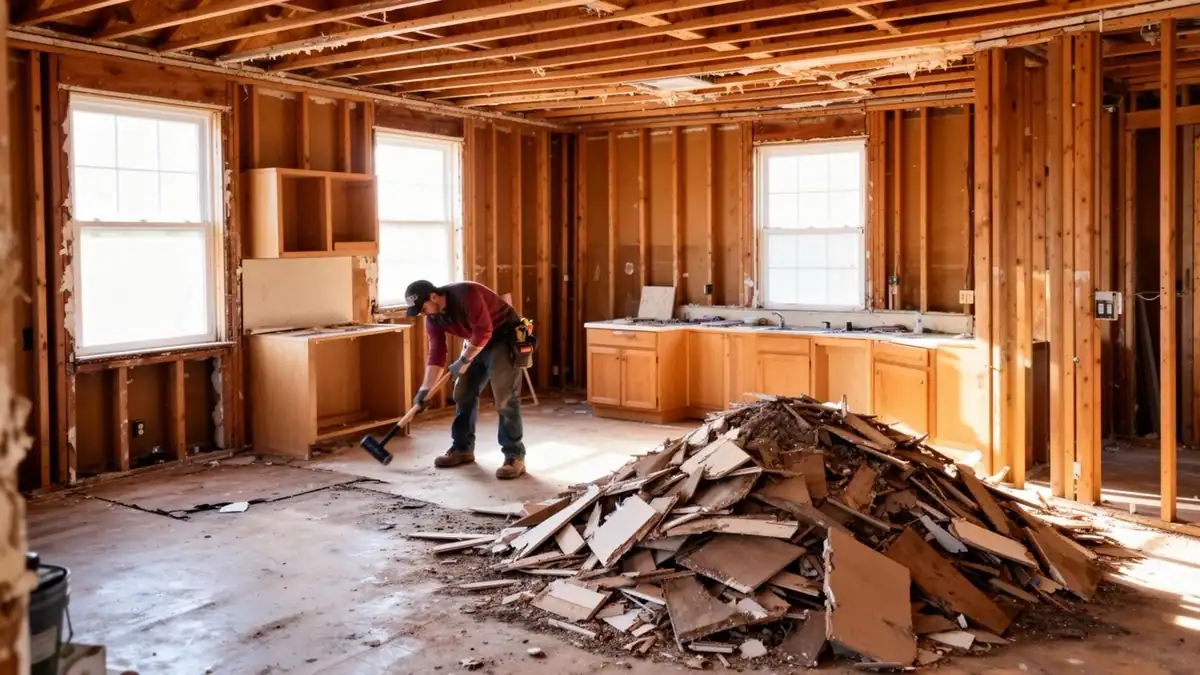
Mold is one of the most common surprises on a Florida rehab, and one of the most commonly overpriced. The confusion comes from treating "remediation" and "demolition" as competing services when they are really two parts of the same job — and understanding which part dominates tells you what you should actually be buying.
The uncomfortable truth about remediation
Here is the thing most property owners do not realize until they are standing in the building: there is no product that fixes moldy porous material. You cannot spray drywall, carpet padding, insulation, or ceiling tile and restore it. Porous materials that have grown mold get removed. Period.
So a large share of any real remediation scope is, functionally, demolition — cutting out and hauling away affected material. What remediation adds on top is containment, negative air, HEPA filtration, worker protection, cleaning of the non-porous materials that stay, and post-work verification.
The question is not "remediate or gut." It is "how much containment does this removal need, and how much of the building is coming out anyway."
When remediation-only makes sense
- Affected area is limited and localized — one bathroom wall, under one window, a small ceiling area
- The cause is identified and fixed
- Most of the building's finishes are staying
- The property is occupied and you need to work around people
Here you want the full controlled process: containment barriers, negative air machines, careful removal of the affected porous material, HEPA cleaning of the remaining surfaces, and clearance testing. It is more expensive per square foot than plain demolition, and it is worth it because you are protecting everything you are not removing.
When gutting is the better answer
- Affected area is widespread across multiple rooms or floors
- The property has had long-term water intrusion or sat vacant with the AC off — extremely common in Florida
- Post-flood or post-storm saturation
- You were planning a full renovation anyway
- The drywall, insulation, and flooring are coming out regardless of mold
At that point, containing a small area inside a building where everything is affected is theater. You are paying premium remediation pricing to remove material you would remove anyway. Gutting the interior to studs removes the substrate, removes the problem, and gives you an open building you can dry, treat, and rebuild — usually faster and often cheaper than a whole-building remediation.
The scope for that is house gutting or interior demolition, performed with appropriate worker protection and dust control.
What has to come out either way
Regardless of which label you use, on a significantly affected property:
- Drywall and plaster in affected areas, cut back well past visible growth
- Insulation — batt insulation is not salvageable once wet
- Carpet, pad, and most flooring including the underlayment
- Ceiling tile and acoustic material
- Affected cabinetry, trim, and MDF anything
- Any porous material that held moisture
Framing lumber, concrete, masonry, and metal are non-porous or semi-porous. They typically get cleaned and dried rather than removed — which is exactly why gutting to studs works: you remove everything that holds mold and keep everything that does not.
Fix the water first
This is the part that turns a one-time cost into a recurring one. If the roof leak, the plumbing leak, the failed window seal, the grading problem, or the humidity control issue is not fixed, mold comes back into the new drywall. In Florida, running the AC in a vacant property is not optional — a closed-up building with no dehumidification grows mold in weeks.
Any competent scope starts by identifying the moisture source. If nobody has, that is your first phone call, not the remediation quote.
Florida licensing, briefly
Florida licenses mold assessors and mold remediators, and the same company generally cannot both assess and remediate the same property — the separation exists so the person diagnosing is not the person selling the cure. On a straightforward gut where the plan is to remove everything porous anyway, an independent assessment before and a clearance after gives you documentation without the conflict.
For an investor, that documentation matters at resale and for disclosure.
The cost comparison, roughly
Remediation carries the extra cost of containment setup, negative air equipment, HEPA cleaning labor, and testing. Gutting carries the cost of removing more material. On a small affected area, remediation is cheaper. On a whole-house or whole-floor problem, gutting usually wins on both price and schedule — and it eliminates the argument about whether the area behind the untouched wall was affected.
Practical sequence for a rehab
- Identify and stop the moisture source
- Get an independent assessment and scope
- Gut the affected areas — usually more than the visible growth
- Dry the structure and verify with moisture readings
- Clean the remaining framing and hard surfaces
- Clearance test
- Rebuild
We handle the removal side across Florida — gut-outs, interior demolition, and debris haul-off — on investor timelines with fixed scopes. Call (689) 323-4676 or request a quote. See also gut renovation cost per square foot.
Fix-and-flip or rehab portfolio?
House gut-outs in 2–5 days. Volume pricing for repeat investors.
Get an Investor QuoteMore in Investor Guides
What It Costs to Get an Industrial Parcel Development-Ready
Between buying a closed plant and putting something new on it sits a set of costs that are predictable if you ask for them.

Buying a Closed Industrial Plant: What to Check First
Closed plants trade at a discount for reasons. Environmental status, structure, equipment and demolition cost decide whether the discount is real.
Gutting a House After Water Damage in Florida
Flooded and storm-damaged houses need a specific kind of gut-out, fast. What comes out, how far up the wall, and why the clock matters in Florida's climate.