
Steel Building Demolition and Scrap Value: Does the Steel Pay for the Job?
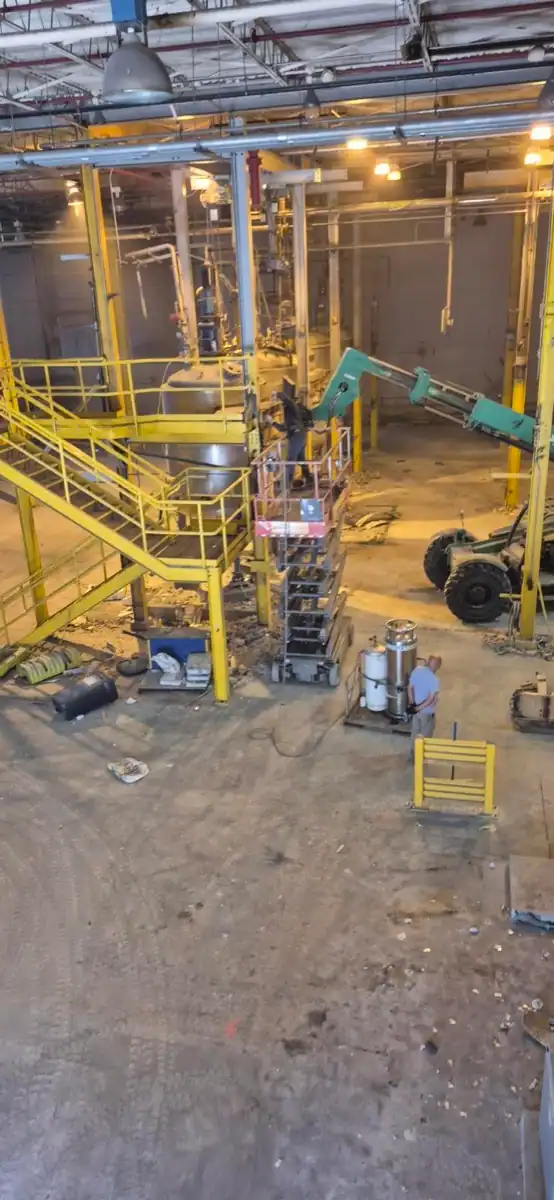
Steel buildings are the friendliest structures on a demolition site. They come apart in a predictable order, they generate very little landfill waste, and almost everything that hits the ground has a market value. On the right project the steel genuinely offsets a meaningful share of the demolition bill — but "offsets" and "pays for" are different words, and it is worth understanding which one applies to your building.
Where the tonnage actually is
A pre-engineered metal building is lighter than people assume. The primary frames — rigid frames or columns and trusses — hold most of the weight. Purlins, girts, bracing, and the roof and wall panels add up but are thin-gauge. A typical single-story pre-engineered building runs on the order of a few pounds of steel per square foot of floor area for the framing, plus panels.
That means a 20,000 sq ft metal building might yield tens of tons of steel, not hundreds. Compare that to the concrete slab under it, which can easily be several hundred tons of material going the other direction on your ledger.
The heavier the frame, the better the math. Older mill buildings, structural-steel warehouses with heavy wide-flange columns, crane-served bays, and industrial racks yield far more per square foot than a light pre-engineered shell.
Scrap grades matter
Not all steel prices the same. Heavy melt — thick structural sections, plate, heavy beams — commands the best price. Light-gauge material like roof and wall panels, purlins, and metal studs falls into a lower grade and, once it is bent and mixed, is worth notably less per ton.
The separating work matters too. Steel that arrives at the yard clean, cut to size, and sorted by grade earns more than a tangled load with insulation, fasteners, and wood mixed in. Part of what you are buying from a competent demolition contractor is the discipline to sort rather than to shove everything in one pile.
And beyond structural steel, the real money on an industrial site is usually non-ferrous: copper wire and bus, motor windings, aluminum, brass, and stainless. Those prices are multiples of steel per pound.
Dismantle vs. demolish
If the building is in good condition and someone wants it, careful dismantling for reuse is worth more than scrapping — a complete pre-engineered building with its drawings can be re-erected elsewhere. But dismantling costs far more in labor, takes longer, and only pays when there is an actual buyer with a plan, not a hypothetical one.
For most retired industrial buildings the honest answer is: demolish efficiently, sort well, and sell the steel by grade.
How the credit shows up in a quote
Two contractors can present the same economics very differently. Some bid a lower gross number and keep the scrap. Others bid the true cost and credit the recovered value back as a line item. The second is more transparent and lets you see what your material is actually worth.
Ask directly: who keeps the scrap, and is its value credited against the bill? If a bid is suspiciously low on a steel-heavy building, the answer is usually that the contractor already priced the steel into their margin.
The bigger offset is rarely the structure
On an industrial site, the building steel is usually the smaller half of the recoverable value. The larger half is the equipment inside it: transformers and switchgear with copper content and resale value as working units, chillers and cooling towers, generators, air compressors, and process machinery.
Sold as working equipment rather than melted as metal, those items are worth many times their scrap weight. That is the core argument in industrial demolition vs. equipment salvage, and it is why we appraise the contents before quoting the teardown.
What still costs money on a steel job
Do not let the scrap credit hide the real costs. You still pay for mobilization, permits and the asbestos survey, abatement if the panels are transite or the roof felt tests positive, the concrete slab and footers, insulation and non-metallic debris disposal, and final grading. Steel buildings are cheap to demolish relative to concrete — they are not free.
Bottom line
On a light pre-engineered building, expect the steel to trim the bill, not erase it. On a heavy structural-steel industrial building full of live mechanical and electrical equipment, the recovered value can cover a substantial share of the job — occasionally the whole thing.
We demolish metal and structural steel buildings across Florida, and because we buy industrial equipment ourselves, we appraise what is inside before we quote what comes down. Call (689) 323-4676 or get a quote. See also warehouse demolition cost in Florida.
Need an interior stripped?
Nationwide interior demolition crews. Fast scheduling. Clean hand-offs.
Request a Demo QuoteMore in Demolition
Strip Mall and Retail Center Demolition in Florida
Older retail centers are coming down across Florida for redevelopment. Here is what drives the cost and schedule on a strip mall teardown.
Gas Station Demolition: What Is Actually Involved
A gas station teardown is a tank closure, a canopy removal, and a building demolition rolled into one regulated project. Here is how it sequences.
Hotel and Motel Demolition in Florida
Florida's aging roadside motels and mid-century hotels are prime redevelopment sites. What drives cost and schedule when one comes down.