
How Long Does Commercial Demolition Take?
The machine work is the fastest part of a commercial demolition. A crew with the right equipment can put a mid-size building on the ground in days. What takes weeks is everything that has to happen legally and logistically before that, and the hauling that happens after. When owners are surprised by a demolition schedule, it is almost always because they were counting the wrong phase.
Here is how the calendar actually breaks down.
Phase 1 — Survey and scoping: 1 to 2 weeks
An asbestos survey by a licensed inspector is required before a permit on essentially any commercial structure in Florida, and lab turnaround on samples is the pacing item. Budget a week for a straightforward building, longer for a large facility with many material types.
At the same time, a good contractor is walking the building to scope what comes out before the structure does — the mechanical and electrical equipment worth recovering, what has to be abated, and how debris will be sorted.
Phase 2 — Permitting and notifications: 2 to 6 weeks
This is usually the longest fixed block. The federal NESHAP notification typically runs a 10-working-day clock before demolition may begin, and it starts when you file, not when you decide. Building department review runs in parallel and varies enormously by jurisdiction — a week or two in a small county, considerably longer in a busy municipal department.
Historic districts, coastal zones, and sites needing environmental review add time that cannot be compressed by paying more.
Phase 3 — Utility disconnects: 1 to 4 weeks (parallel)
Electric, water, sewer, and gas each need to be disconnected and documented by the provider. These run on utility schedules. Start them the same week you file the permit and they usually clear inside the permitting window; start them late and they become the critical path.
Phase 4 — Abatement, if required: 1 to 4+ weeks
If the survey finds regulated asbestos, a licensed abatement contractor has to remove it before demolition, under containment, with its own notification and clearance testing. Small localized abatement can be a few days. A building with widespread transite panels or extensive pipe insulation can be a month or more.
This is the phase with the widest variance, and it is why an honest contractor will not give you a firm end date before the survey comes back.
Phase 5 — Equipment recovery and soft strip: 3 days to 3 weeks
Before the structure comes down, anything with resale value comes out: chillers, boilers, generators, transformers, switchgear, air compressors, racking, and copper. On a plant or a well-equipped warehouse, this phase pays for itself several times over — see how equipment recovery offsets demolition cost.
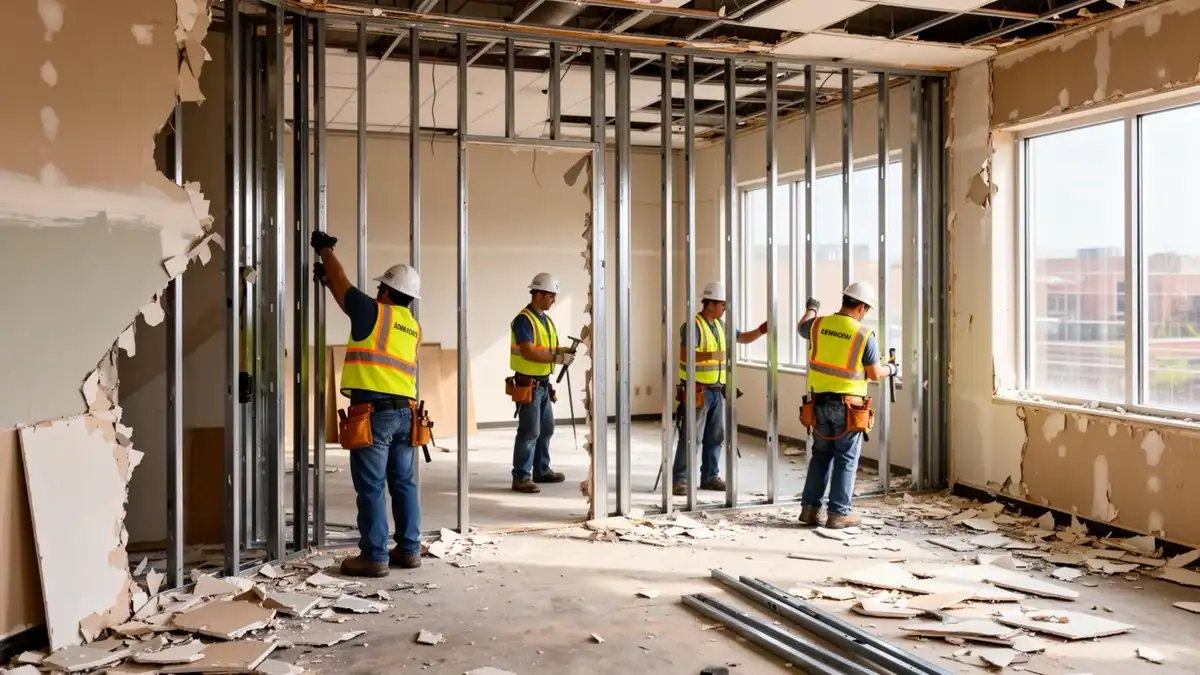
Interior soft-strip — drywall, ceilings, flooring, fixtures — happens here too when the debris needs to be separated for recycling or when only interior demolition is in scope.
Phase 6 — Structural demolition: 2 days to 3 weeks
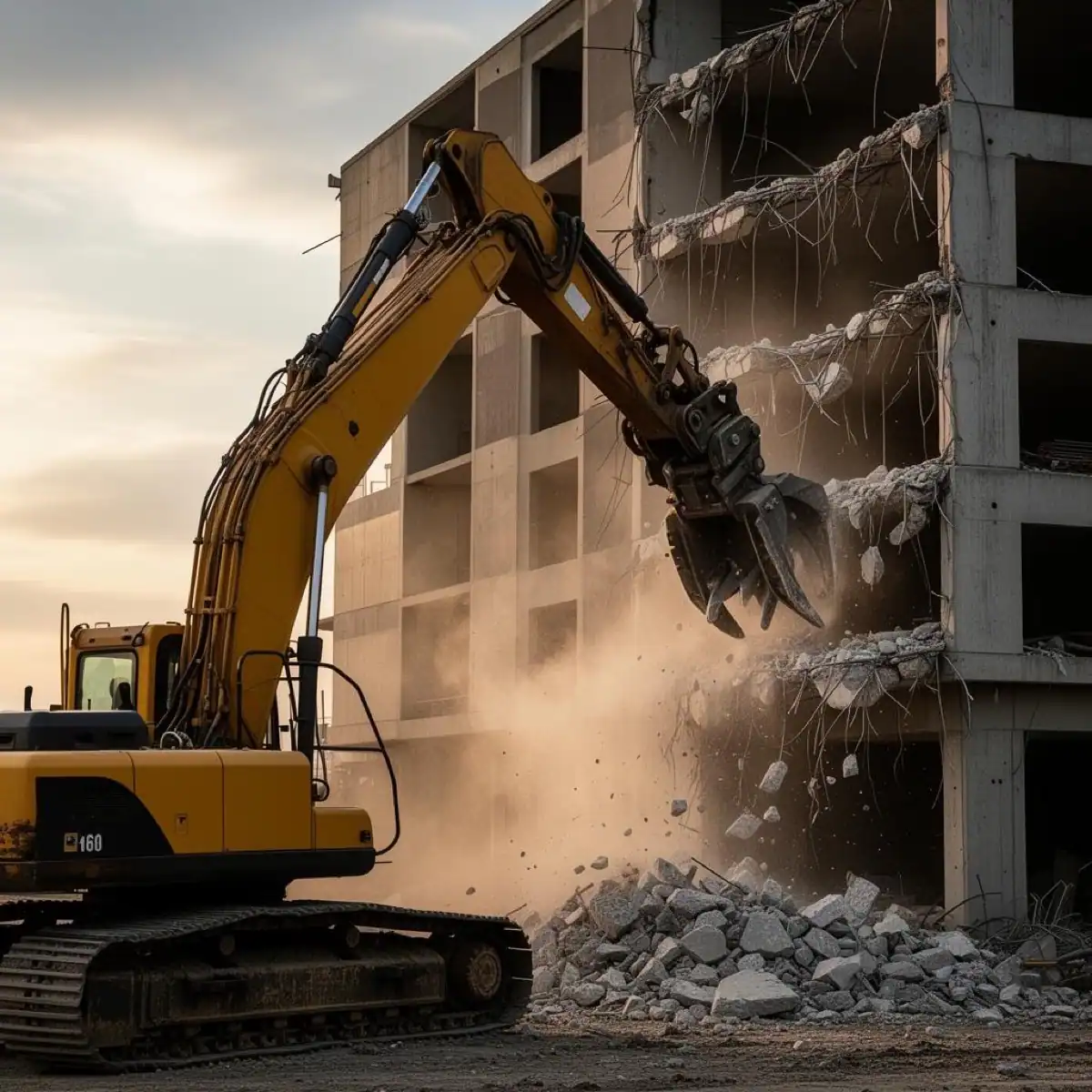
Now the fast part. A single-story metal building on an open lot can be down in a couple of days. A multi-story concrete structure, a building attached to occupied space, or a site with tight access and restricted work hours takes longer — sometimes much longer, because the constraint is protection and sequencing, not machine capacity.
Phase 7 — Debris hauling: overlapping, 1 to 4 weeks
Hauling runs alongside and past the teardown, and it is governed by tonnage and truck cycles, not by how fast the building fell. A concrete-heavy building generates far more loads than a steel one. Distance to the recycler or landfill, allowed haul routes, and how many trucks the site can turn per hour all set the pace here.
Phase 8 — Slab, footers, grading, and closeout: 3 days to 2 weeks
If the slab and foundations come out, that is its own tonnage exercise — see concrete slab removal cost. Then backfill, compaction, grading, and often seeding, followed by the final inspection that closes the permit.
Realistic totals
- Small commercial building, clean survey, open site: roughly 4 to 8 weeks from decision to closed permit, most of it paperwork.
- Mid-size warehouse or light plant: 8 to 14 weeks.
- Large industrial facility with abatement and heavy equipment recovery: 3 to 6 months.
How to compress it
The two levers that actually work are starting the survey immediately and filing the notification and utility requests the same week. Everything else — crew size, equipment, work hours — affects the short phases, not the long ones.
We run demolition, equipment recovery, and debris removal with one crew and one point of contact across Florida, which removes the hand-off delays that stretch multi-vendor projects. Call (689) 323-4676 or request a quote. Permit specifics are in how to get a demolition permit in Florida.
Need an interior stripped?
Nationwide interior demolition crews. Fast scheduling. Clean hand-offs.
Request a Demo QuoteMore in Demolition
Strip Mall and Retail Center Demolition in Florida
Older retail centers are coming down across Florida for redevelopment. Here is what drives the cost and schedule on a strip mall teardown.
Gas Station Demolition: What Is Actually Involved
A gas station teardown is a tank closure, a canopy removal, and a building demolition rolled into one regulated project. Here is how it sequences.
Hotel and Motel Demolition in Florida
Florida's aging roadside motels and mid-century hotels are prime redevelopment sites. What drives cost and schedule when one comes down.