
Industrial Demolition in Jacksonville, FL: What the Market Looks Like
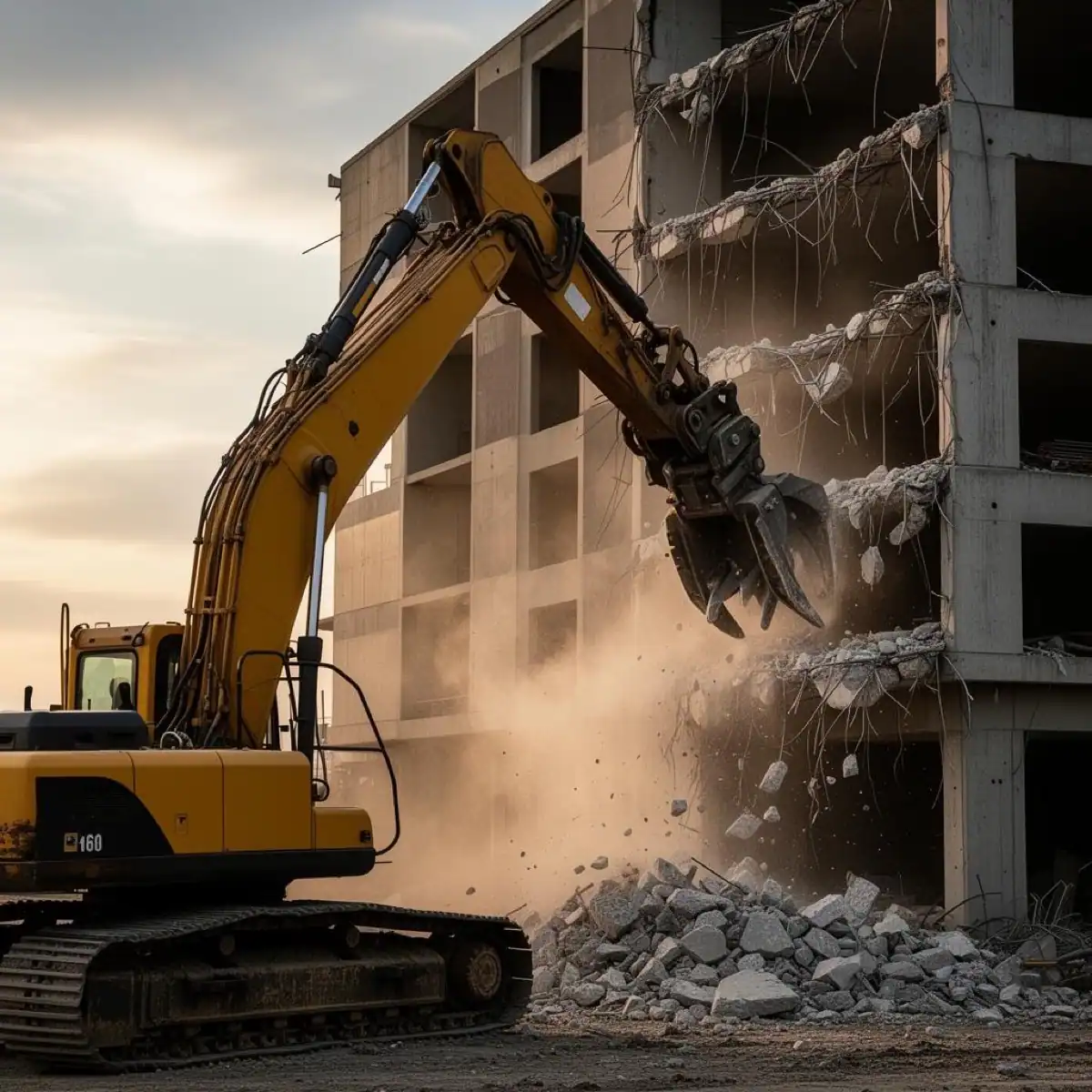
Jacksonville is one of Florida's genuine industrial cities. Between JAXPORT, the CSX rail network headquartered there, the Westside and Northside industrial corridors, and decades of manufacturing and distribution build-out, Duval County has a deep stock of aging industrial buildings — and a steady flow of them coming out of service as logistics operators rebuild for modern clear heights and dock ratios.
That combination makes Jacksonville an active market for industrial demolition and, just as importantly, for equipment recovery.
What comes down in Jacksonville
The projects cluster into a few recognizable types:
Port and warehouse stock. Older transit sheds, cold storage, and low-clear warehouses near the port and along the river that no longer fit modern distribution requirements. These are frequently redeveloped rather than retrofitted because the racking geometry cannot be fixed.
Rail-served industrial. Buildings along the CSX lines built around rail spurs that are no longer used, often with heavy floors, cranes, and substantial electrical service — which is exactly the profile that carries recoverable equipment value.
Manufacturing and processing. Older plants across the Northside and Westside, many with real mechanical infrastructure: boilers, chillers, compressed air, and large electrical services.
Institutional and commercial conversion. Retail and office structures being cleared for industrial or mixed-use redevelopment, usually needing selective demolition or full teardown plus slab removal.
What drives cost here
The same fundamentals apply as anywhere in Florida — structure type, tonnage, abatement, and slab removal — but a few Jacksonville-specific factors show up repeatedly.
Older building stock means more abatement. Jacksonville has a lot of mid-century industrial construction, and mid-century construction means transite panels, pipe lagging, roofing felt, and floor mastic. Get the asbestos survey early, because in this market it is more likely than not to find something.
Heavier electrical services. Rail-served and manufacturing properties often carry substantial services — multiple transformers, switchgear lineups, and motor control centers. This is where recovery value concentrates.
Site constraints near the port and river. Stormwater and environmental controls are taken seriously near the St. Johns, and haul routes through industrial corridors have their own restrictions.
Foundations. Older heavy industrial floors are thick, and equipment piers under retired machinery are deeper than the visible slab. Budget the slab and footer removal as its own line item.
Permitting and timeline
Duval County and the City of Jacksonville handle demolition permitting, and the sequence is the standard Florida one: licensed contractor, asbestos survey, NESHAP notification with its ten-working-day clock, utility disconnects documented, then the permit package. Historic districts around Springfield and downtown add review layers that are worth identifying at the very start of a project rather than midway through.
Plan on four to ten weeks from decision to legal start for a straightforward industrial building, longer if abatement is significant. The full breakdown is in how long commercial demolition takes.
Equipment recovery: the part that changes the number
The reason we work Jacksonville from our Auburndale yard is that Northeast Florida industrial buildings are frequently equipment-rich. Before a structure comes down we appraise what is inside — chillers, boilers, generators, transformers, switchgear, air compressors, pumps, and process equipment — and credit its value against the demolition bill.
That is not a small adjustment on a plant or a rail-served manufacturing building. It is often the difference between a demolition project and a decommissioning project that partly funds itself. The mechanics are in how equipment recovery offsets demolition cost.
Being honest about distance
Jacksonville is not a local metro for us the way Tampa and Orlando are — our yard is in Auburndale, in Polk County, roughly three hours south. We work Northeast Florida as a mobilized crew, which is the right model for full-facility teardowns and equipment recovery projects where the scope justifies bringing a full crew and equipment spread north.
For a small selective strip-out we will tell you honestly if a local Jacksonville contractor is the better economic answer. For a plant decommissioning where equipment value is on the table, being the buyer and the demolition contractor generally beats hiring two companies who each take a margin.
Get a Jacksonville project scoped
Send us the building type, square footage, what equipment is still installed, and whether the slab comes out. We will come back with a scope, a schedule, and an honest read on the recovery value.
Call (689) 323-4676 or request a quote. See also: industrial demolition across Florida and used chillers in Jacksonville.
Need an interior stripped?
Nationwide interior demolition crews. Fast scheduling. Clean hand-offs.
Request a Demo QuoteMore in Demolition
Strip Mall and Retail Center Demolition in Florida
Older retail centers are coming down across Florida for redevelopment. Here is what drives the cost and schedule on a strip mall teardown.
Gas Station Demolition: What Is Actually Involved
A gas station teardown is a tank closure, a canopy removal, and a building demolition rolled into one regulated project. Here is how it sequences.
Hotel and Motel Demolition in Florida
Florida's aging roadside motels and mid-century hotels are prime redevelopment sites. What drives cost and schedule when one comes down.