
Air-Cooled vs Water-Cooled Used Chillers
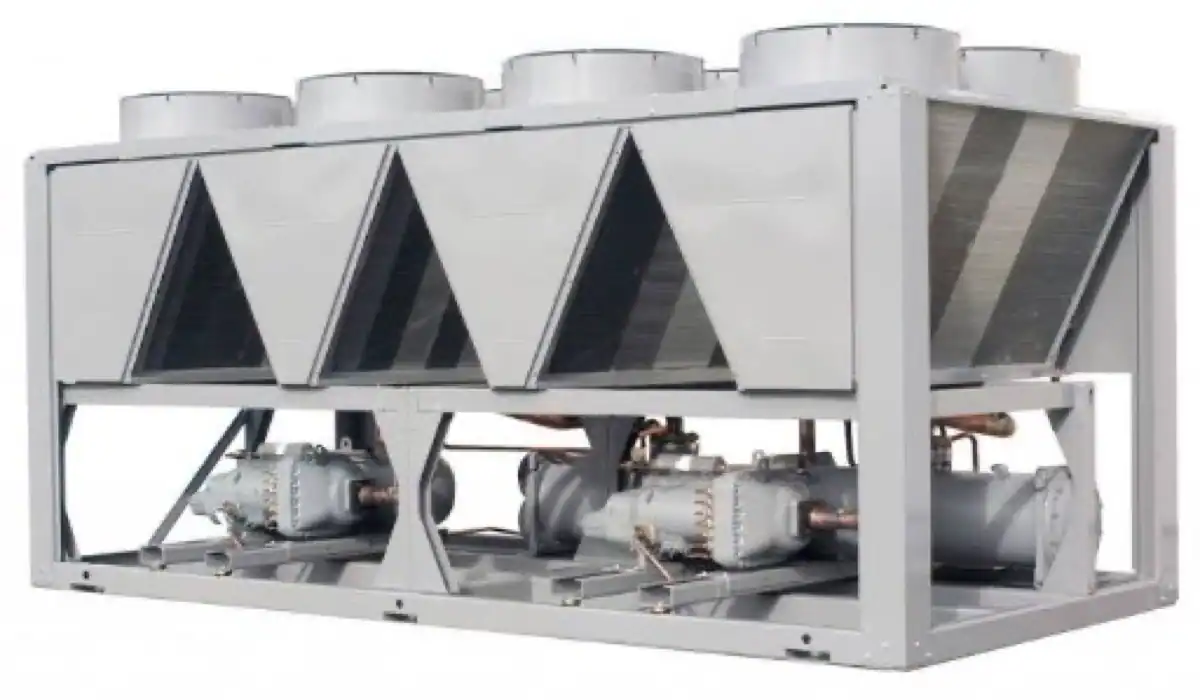
Air-cooled or water-cooled is the first real fork in the road when you're buying a used chiller, and getting it wrong means buying a unit that fights your site instead of fitting it. We resell both, and the right answer comes down to your tonnage, your water situation, your install budget, and — this being Florida — how the climate treats each one. Here's the operator's breakdown.
The one-line version: air-cooled is simpler and cheaper to install but less efficient and shorter-lived; water-cooled is more efficient and longer-lived but needs a cooling tower, condenser water loop, and more maintenance. Above roughly 400 tons, water-cooled almost always wins. Below 200, air-cooled often makes more sense.
How they actually differ
- Air-cooled rejects heat straight to the outside air through a condenser coil and fans. The whole unit sits outside or on the roof. No cooling tower, no condenser water pumps, no water treatment.
- Water-cooled rejects heat to a condenser water loop that runs to a cooling tower. The chiller lives indoors; the tower lives outside. More components, more plumbing, more efficiency.
Cost and install scope
- Air-cooled is cheaper to buy per ton at smaller sizes and much cheaper to install — set it, run refrigerant and power, done. Great when you don't have room or budget for a tower and a mechanical room.
- Water-cooled costs more to install because you're also buying or reusing a cooling tower, condenser water pumps, piping, and water treatment. But the unit itself often costs less per ton at large tonnages, and the efficiency pays back over time.
For the full install picture in-state, see cost to install a used chiller in Florida.
Efficiency — where water-cooled pulls ahead
Water-cooled chillers are meaningfully more efficient because water rejects heat better than air. In Florida's year-round cooling climate, that efficiency gap runs the whole calendar, not just summer.
- Water-cooled centrifugals in the 500-to-1,500-ton range post the best efficiency numbers on the market. Over a long ownership horizon, the lower kilowatt draw is real money.
- Air-cooled units work harder on hot, humid Florida afternoons — exactly when your load peaks — so their efficiency dips right when you need capacity most.
If your load is large and runs constantly, the water-cooled efficiency advantage usually justifies the extra install cost.
Maintenance and lifespan
- Air-cooled has fewer systems to maintain — no tower, no condenser water treatment — but the outdoor coils take a beating. In coastal Florida, salt air corrodes air-cooled condenser coils fast, and that shortens the unit's useful life. Expect more frequent coil service and a shorter run than an equivalent indoor unit.
- Water-cooled lasts longer because the chiller itself lives indoors, protected from weather. The trade-off is the tower needs water treatment, and condenser tubes need periodic cleaning to fight scale — especially on hard Florida water.
This is a big deal near the coast. For a beachfront hotel or a plant near the water, the corrosion math often tips toward water-cooled even at tonnages where air-cooled would otherwise win. When you inspect either type, coil and corrosion condition is critical — see what to inspect before buying a used chiller.
Which one fits your building
- Under 200 tons, tight budget, no tower: air-cooled. Simpler, cheaper, faster to install. Common for smaller warehouses and light commercial.
- 200 to 400 tons: it depends — run the efficiency and install numbers both ways.
- Over 400 tons, constant load: water-cooled centrifugal. The efficiency and lifespan win at scale. See buying a used centrifugal chiller.
- Coastal site at any tonnage: lean water-cooled to dodge salt corrosion, unless install constraints rule out a tower.
- Existing tower and condenser loop already on site: water-cooled is a near-automatic call — you've already got the expensive part.
Whichever way you go, size it to your real load. Oversizing in humid Florida causes short-cycling and comfort problems — see how to size a used chiller.
Rigging and install differences
The two types don't just cost different amounts to run — they cost different amounts to get in place, which matters when you're comparing used units.
- Air-cooled is usually a single lift onto a slab or roof. Heavy, but one piece. A 300-ton air-cooled unit can run 12,000 to 18,000 pounds and often needs a crane, but once it's set you're mostly done.
- Water-cooled is a smaller chiller footprint but more total work — you're placing the chiller indoors, then tying into or installing a cooling tower, condenser water pumps, and piping. More trades, more days, more permits.
Rooftop air-cooled placement in an urban market like Miami or Fort Lauderdale can mean street closures and permit fees that dwarf a slab drop at a Polk County warehouse. Factor the rigging into your total, not just the purchase price — see used chiller delivery and rigging in Florida.
Noise and placement
One more real-world factor: air-cooled units put their condenser fans outside, which means fan noise at the property line. For a hotel courtyard or an office next to a residential lot, that noise can be a problem. Water-cooled keeps the chiller indoors and pushes only the cooling tower outside, which is generally quieter and easier to screen. In tight urban Florida sites, that placement flexibility sometimes decides the call on its own.
Bottom line
Air-cooled wins on simplicity and install cost, especially under 200 tons and where there's no tower. Water-cooled wins on efficiency and lifespan, especially over 400 tons, on constant loads, and on coastal Florida sites where salt air punishes outdoor coils. Match the type to your tonnage, your water access, and your exposure to the climate — not to whichever is cheaper on day one.
We resell both configurations across every tonnage band and can tell you which one your site actually wants. Send us your load and location and we'll match you to the right unit or make a cash offer on yours, or reach out here.
Looking for used equipment?
We move chillers, boilers, generators, and cooling towers across Florida and nationwide. Tell us what you need.
Ask About Available UnitsMore in Buying Guides
Buying Used Machine Tools From a Plant Closure
Machine tools from a closing facility can be the best value in industrial equipment, provided you evaluate wear, controls and what it takes to move.
Inspecting a Used Industrial Boiler Before You Buy
Pressure vessel condition, jurisdiction paperwork and burner package all decide whether a used boiler is a bargain or an ornament.
Load Testing a Used Generator Before You Buy
Hours mean little without a load test. What to test, what to look for, and what a generator's history tells you.