
How to Size a Used Chiller for Your Building
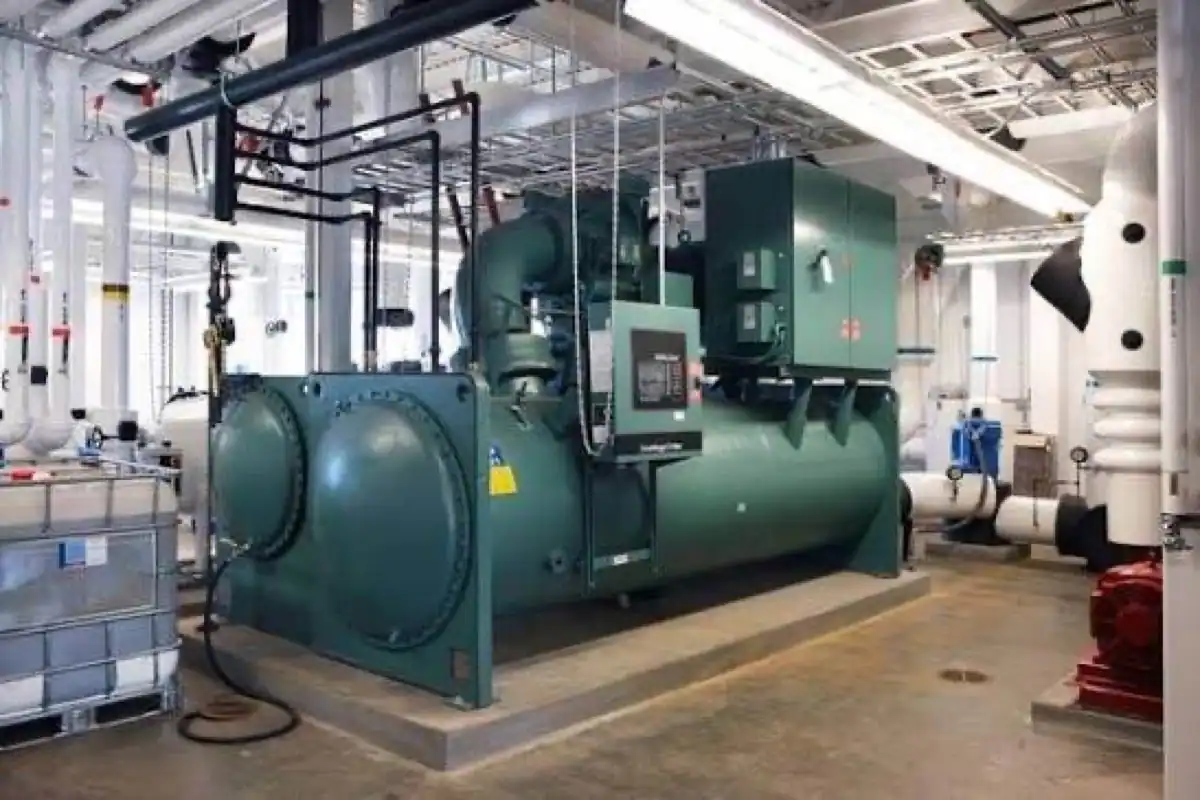
The most expensive mistake we see used-chiller buyers make isn't buying a bad unit — it's buying a fine unit in the wrong size. Oversizing feels safe. It isn't, especially in Florida. This is how we help buyers land on the right tonnage before they commit to a purchase they'll live with for 15 to 20 years.
Sizing a chiller means matching its cooling capacity, measured in tons, to your building's peak cooling load. One ton equals 12,000 BTU per hour of heat removal. Get it right and the unit runs efficiently for decades. Get it wrong and you either can't keep up on a hot day or you short-cycle your way to comfort and reliability problems.
Why oversizing is a real problem — not a safety margin
Buyers assume a bigger chiller is a safer bet. In a humid climate it's the opposite.
- Short-cycling. An oversized chiller satisfies the temperature setpoint fast, shuts off, then restarts a few minutes later. Constant stop-start wears the compressor, spikes energy use, and hammers reliability.
- Poor dehumidification. This is the Florida killer. A chiller pulls moisture out of the air only while it runs. An oversized unit runs in short bursts, so it never runs long enough to dehumidify. The result is a building that's cold and clammy — 72 degrees and 65 percent humidity, which feels terrible and grows mold.
- Wasted capital. You pay more for the bigger unit, more to rig its extra weight, and more to run it inefficiently. All to be worse off.
Undersizing has the obvious problem — it can't hold setpoint on a design day — but oversizing is the sneaky, expensive one, and it's the one buyers walk into.
Start with a real load calculation
Rules of thumb get you in the neighborhood, but a proper load calculation gets you the actual number. The industry standard is an ACCA Manual N (commercial) or Manual J (smaller) calculation, which accounts for:
- Square footage and ceiling height — your conditioned volume.
- Building envelope — insulation, glass area, orientation, and how much sun the walls take.
- Occupancy — people generate heat and, in Florida, latent load through moisture.
- Internal loads — lighting, equipment, and process heat. A data center or kitchen is a totally different animal from an open warehouse.
- Ventilation and infiltration — outside air brought in, which in Florida drags in humidity you have to remove.
If you don't have a current load calc, get one from a mechanical engineer before you buy. It's cheap insurance against a five- or six-figure sizing mistake.
Rules of thumb — use these to sanity-check, not to buy
Once you have a load number, these ballparks tell you whether it's in a sane range for your building type:
- General office / commercial: roughly 300 to 400 square feet per ton.
- Warehouse (conditioned): roughly 500 to 1,000 square feet per ton, depending on insulation and use.
- Retail / high-occupancy: roughly 200 to 300 square feet per ton.
- Data center / heavy process: driven by equipment kilowatts, not floor area — size to the heat load, not the square footage. See used chillers for data centers.
These are starting points. Florida's humidity, sun exposure, and outside-air requirements push most buildings toward the denser end of these ranges because latent load is higher here than almost anywhere.
The Florida humidity factor
Standard load calcs split cooling into sensible (temperature) and latent (moisture) load. In Florida, the latent portion is unusually large — you're removing a lot of water, not just heat. Two things follow:
- Don't size on sensible load alone. Make sure the calculation accounts for the moisture you have to pull out, especially in high-occupancy or high-ventilation buildings.
- Favor a unit that dehumidifies well at part load. A chiller with good part-load turndown holds humidity in check on mild days when the sensible load drops but the moisture load doesn't. This favors modular and variable-speed units.
Match the sized load to the right unit
Once you know your tonnage, the used-market decisions fall into place:
- Air-cooled or water-cooled — your tonnage and site drive this. See air-cooled vs water-cooled used chillers.
- Centrifugal or screw — centrifugals shine at large, steady loads; screws handle variable loads and smaller tonnages well. See buying a used centrifugal chiller and buying a used screw chiller.
- Redundancy — if you can't afford downtime, two smaller chillers sized for N+1 beats one big one. This is common in hotels and data centers.
Then run the candidate through our buying checklist to confirm it's a unit worth its price.
A note on redundancy and staging
If your load varies a lot or downtime is unacceptable, splitting the load across two units — or a modular setup — is often smarter than one large chiller. You get better part-load efficiency, you can service one while the other runs, and you match capacity to demand instead of running one oversized machine at half load. In a Florida hotel or hospital, that staging flexibility is worth the slight cost premium.
Bottom line
Size to your real load, not to a fear of coming up short. Get a proper load calculation, sanity-check it against the rules of thumb for your building type, and make sure it accounts for Florida's heavy latent load. Oversizing is the expensive mistake — it short-cycles, fails to dehumidify, and wastes money. Right-sizing keeps a used chiller running efficiently for two decades.
Tell us your building type, square footage, and use, and we'll help you land on the right tonnage and match it to a unit — or make a cash offer on one you're replacing. Ready to talk it through? Reach out here.
Looking for used equipment?
We move chillers, boilers, generators, and cooling towers across Florida and nationwide. Tell us what you need.
Ask About Available UnitsMore in Buying Guides
Buying Used Machine Tools From a Plant Closure
Machine tools from a closing facility can be the best value in industrial equipment, provided you evaluate wear, controls and what it takes to move.
Inspecting a Used Industrial Boiler Before You Buy
Pressure vessel condition, jurisdiction paperwork and burner package all decide whether a used boiler is a bargain or an ornament.
Load Testing a Used Generator Before You Buy
Hours mean little without a load test. What to test, what to look for, and what a generator's history tells you.